- 1. Why Ushuaia Works as an Adventure Base
- 2. The Beagle Channel: Adventure on the Water
- 3. Walking with Penguins at Isla Martillo
- 4. Tierra del Fuego National Park and the Trails
- 5. Off-Road into the Fuegian Interior
- 6. Winter in Ushuaia: The Season Nobody Plans For
- 7. The Pier: Antarctica and the Southern Voyages
- 8. Matching the Adventure to Your Season
- 9. How Long to Stay, and What It Costs You
- 10. Planning an Adventure-First Trip
- 11. Frequently Asked Questions
Ushuaia has a branding problem, and it’s the sign at the edge of town.
Fin del Mundo. The End of the World. Everyone photographs it, posts it, and moves on — and a remarkable number of visitors treat the city as exactly that: a photograph, a bowl of king crab, and a flight out.
Which is a strange fate for a place wedged between the Beagle Channel and the last mountains of the Andes, surrounded by some of the most adventurous terrain in Argentina.
This is the southernmost city on earth, and it functions less like a destination than like a basecamp. Everything here points outward — to the water, into the forest, up the glacier, or south across the Drake Passage.
The best Ushuaia Argentina tours for adventure aren’t sightseeing at all. They’re boats into wildlife colonies, treks to glacial lagoons, off-road runs into the Fuegian interior, and in winter, one of the more unusual adventure scenes in South America.
That winter part is the piece most travelers never learn. Ushuaia is one of the few places in Patagonia with a genuine second season — and for adventure, it may be the better one.
So this guide covers what you can actually do here, by season and by appetite: the water, the trails, the snow, the wildlife, and the voyages that leave from the pier.
Not the sign. Everything past it.
1. Why Ushuaia Works as an Adventure Base
The geography explains it. Ushuaia sits on a narrow strip between the Beagle Channel and the Martial mountains, meaning water and altitude are both within minutes of the centre.
You can be on a boat among sea lion colonies within half an hour of breakfast, or climbing toward a glacier viewpoint above the rooftops in about the same time.
That compression is unusual in Patagonia, where activities are normally separated by hours of driving. Here, the adventures stack.
It also has genuine city infrastructure — proper hotels, restaurants, outfitters, and an airport with reliable connections — which makes it far easier to base yourself here than in the region’s smaller trekking villages.
And it has the pier. Ushuaia is the departure point for the overwhelming majority of Antarctic expeditions, which gives the town a particular expedition atmosphere you don’t find elsewhere.
Our Ushuaia tours are built around that stacking — the channel, the national park, and the mountains behind town, without long transfers eating the days.

2. The Beagle Channel: Adventure on the Water
The channel is Ushuaia’s defining feature and its most reliable adventure, and it delivers regardless of fitness.
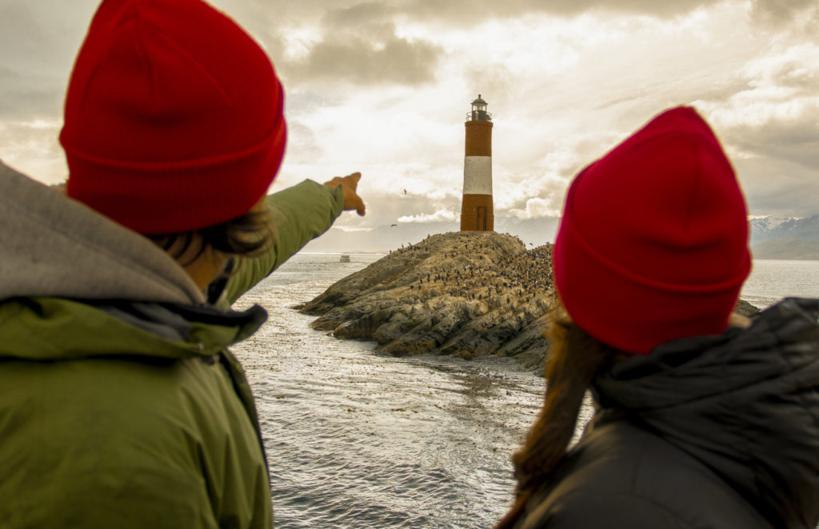
Navigations head out past islands crowded with South American sea lions and imperial cormorants, and to the Les Éclaireurs lighthouse — the red-and-white tower standing alone on a rocky islet that appears on every postcard of the region.
The water itself carries the weight of history. These are the channels Darwin sailed, named for his ship, and the sense of being at the end of the charts is genuine rather than marketed.
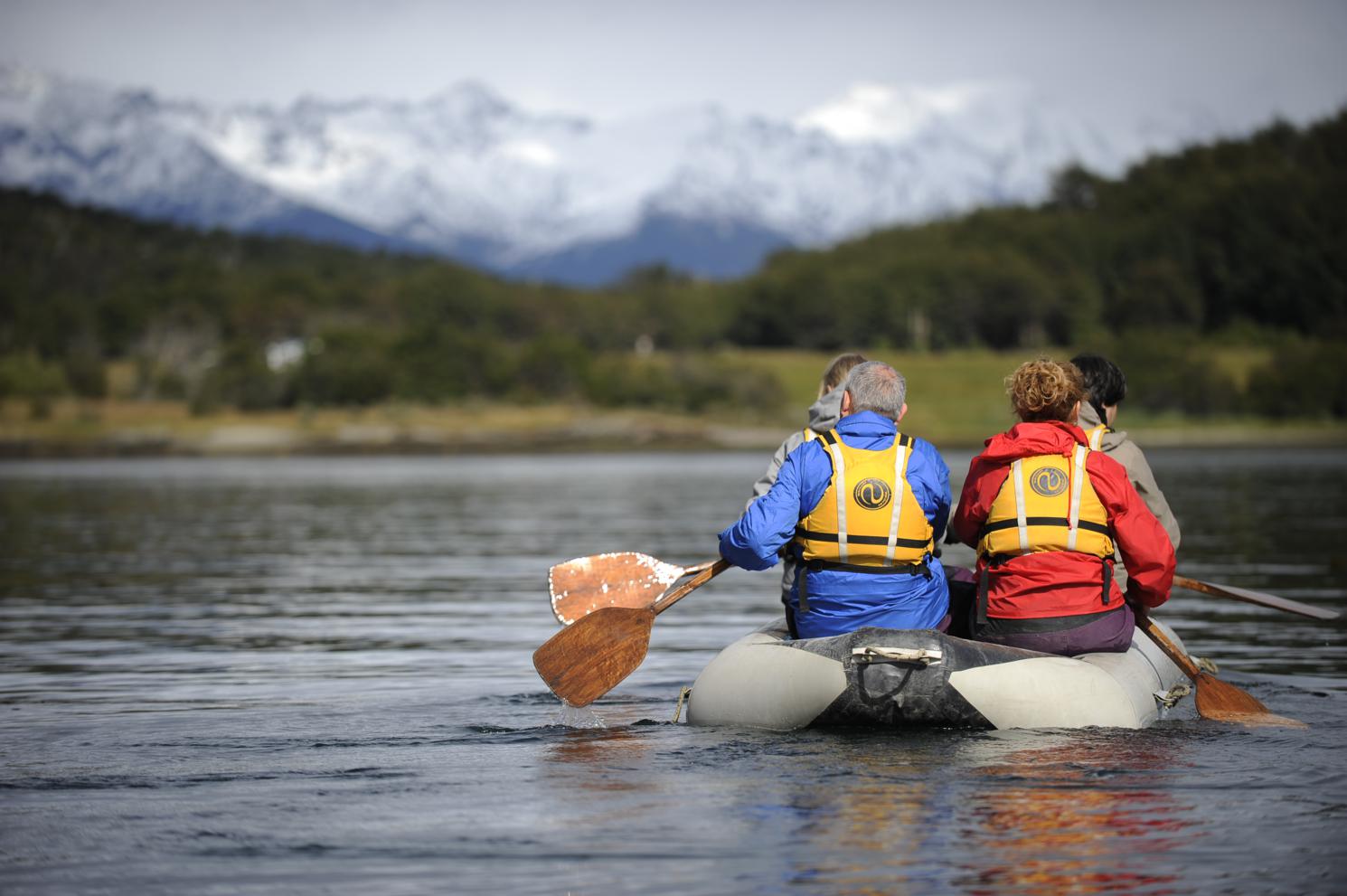
For a more active version, sea kayaking on the channel puts you at the waterline rather than above it, paddling among kelp beds with the Andes rising behind you.
Some navigations include a landing and a short trek on one of the islands, which turns a boat trip into a half-day of genuine exploration.
The channel also runs year-round, which makes it the one Ushuaia adventure that never depends on your season.

3. Walking with Penguins at Isla Martillo
This is Ushuaia’s most distinctive wildlife experience, and it’s worth understanding what makes it different from penguin watching elsewhere.
Isla Martillo, in the Beagle Channel, hosts colonies of Magellanic and Gentoo penguins — and on certain permitted excursions, small groups are allowed to land and walk among them rather than watching from a boat.
Being at ground level, on the island, with penguins moving around you at close range is an entirely different experience from a rail on a vessel.
Numbers are strictly limited to protect the colony, which means these landings book out well ahead and cannot be arranged spontaneously.
The season runs roughly October to March or April, when the birds are present to breed and raise chicks.
Many excursions combine the island with Estancia Harberton, the oldest ranch in Tierra del Fuego, adding a layer of Fuegian pioneer history to a wildlife day.

4. Tierra del Fuego National Park and the Trails
Just west of the city, Tierra del Fuego National Park runs to the Chilean border and offers the gentlest adventure on this list — and the most accessible.
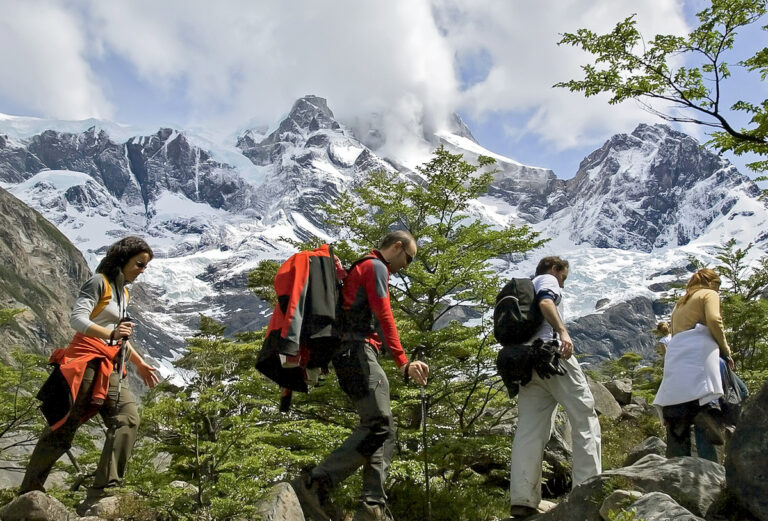
Its trails wind through lenga and ñire forest, along coastline, and around peat bogs and beaver-dammed streams, with well-graded paths suitable for essentially any fitness level.
In autumn the forest turns an extraordinary scarlet and gold, which is arguably when the park is at its best and when almost nobody is there.
For harder walking, the standout is Laguna Esmeralda — a trek to a startlingly turquoise glacial lagoon ringed by peaks, boggy and demanding in places but achievable in a day by anyone reasonably fit.
Above town, the Martial Glacier trail climbs steeply from the edge of the city to a viewpoint over the Beagle Channel that is one of the finest panoramas in Argentina.
These trails share a virtue that matters for adventurous travelers: none require the reservation chains that govern Torres del Paine. You can decide in the morning and go.
5. Off-Road into the Fuegian Interior
North of the city, the island opens into a landscape of lakes, peat bogs and forest that most visitors never see, and the way in is by 4×4.
Off-road excursions run toward Lago Escondido and Lago Fagnano — the latter an enormous body of water stretching across the island into Chile — on tracks that are genuinely rough rather than scenic-drive smooth.
These trips typically combine driving with short treks, canoeing on a lake, and a Fuegian asado in the forest, which makes them one of the better full-day options for travelers who want variety.
The appeal is access. This is terrain you cannot reach on foot in a day or in a standard vehicle, and it feels considerably wilder than the national park.
It also suits mixed groups well, since the driving does the hard work and the walking sections can be scaled.
Adventure-focused itineraries can combine these with the channel and the park across a few days — our active and adventure trips are structured that way rather than around sightseeing stops.
6. Winter in Ushuaia: The Season Nobody Plans For
Here is what most Patagonia coverage misses entirely: Ushuaia has a real winter season, and for adventure it’s arguably the more interesting one.
While the rest of Patagonia largely closes between June and September, Ushuaia opens. The surrounding mountains hold reliable snow, and the town becomes a genuine winter sports destination.
Cerro Castor, just outside the city, is the southernmost ski resort in the world, with a season that runs roughly from June to October — which makes it a curiosity for Northern Hemisphere skiers wanting to ski in July.
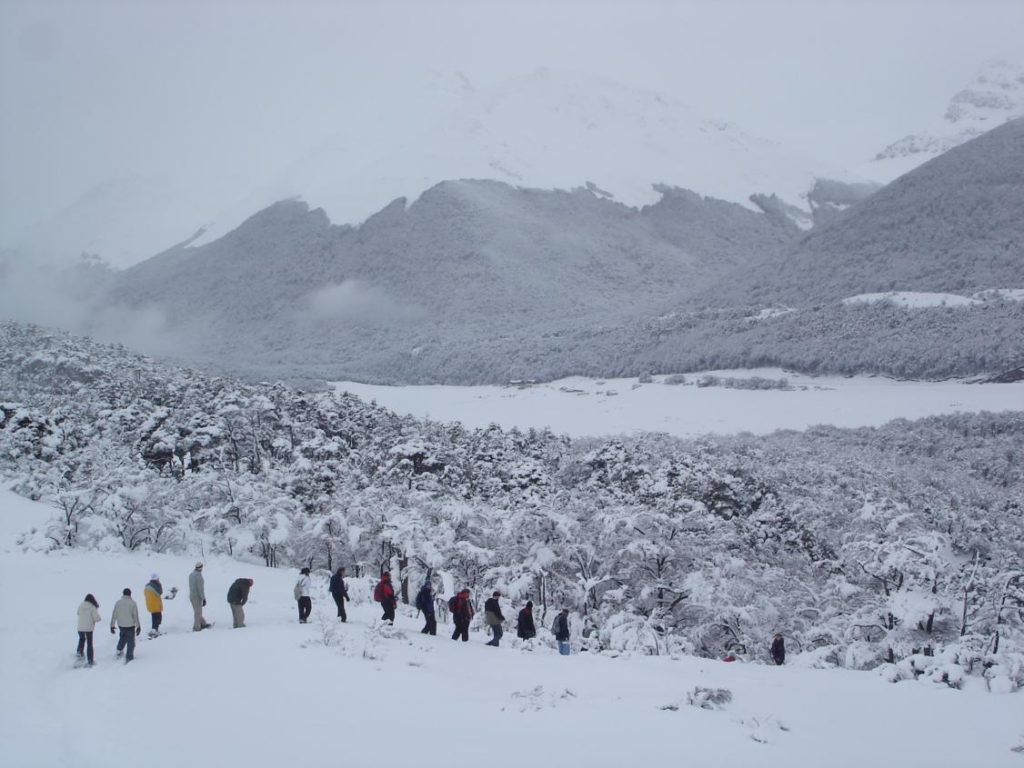
Beyond the pistes, the winter adventures are the distinctive ones: dog sledding through snow-covered valleys, snowmobiling into the interior, snowshoeing through silent lenga forest, and cross-country skiing in the valleys behind town.
Winter also brings very short days — the sun barely clears the mountains in June — which is either a drawback or the entire point, depending on the traveler.
For anyone who has already done Patagonia in summer and wants something genuinely different, a winter trip to Ushuaia is the least obvious and most rewarding option in this article.
7. The Pier: Antarctica and the Southern Voyages
No account of adventure in Ushuaia is complete without the ships, because they define the town’s character even for travelers who never board one.
The overwhelming majority of Antarctic expeditions depart from here, crossing the Drake Passage to the peninsula — typically eight to ten days, including two crossings that are part of the experience rather than an inconvenience to be minimised.
Longer voyages add South Georgia and the Falklands, and specialised departures target the emperor penguin colonies.
Shorter fjord cruises also leave the region, sailing the channels of Tierra del Fuego toward Cape Horn — the legendary meeting point of the Atlantic and Pacific — which is a genuine expedition without the commitment of a full Antarctic crossing.
The practical point for planning: if Antarctica is in your thinking, treat it as its own trip attached to Ushuaia rather than an extension of a Patagonia itinerary. It cannot be compressed, and the departure date is fixed.
Our Antarctica cruises depart from here, and the Ushuaia and Antarctica adventure combines the town’s own adventures with the voyage south.
8. Matching the Adventure to Your Season
Ushuaia is one of the few Patagonian destinations where the season genuinely changes what’s on offer rather than merely how comfortable it is.
The table below is the quickest way to see what your dates actually allow.
| Adventure | Season | Notes |
| Beagle Channel navigation | Year-round | The most reliable adventure; runs in any season |
| Penguin landing, Isla Martillo | Oct–Mar/Apr | Strictly limited numbers; book well ahead |
| Tierra del Fuego trails | Oct–Apr | Autumn colour in Mar–Apr is exceptional |
| Laguna Esmeralda trek | Oct–Apr (summer) | Boggy; also done on snowshoes in winter |
| 4×4 into the interior | Oct–Apr | Lakes Escondido and Fagnano |
| Skiing at Cerro Castor | Jun–Oct | Southernmost ski resort in the world |
| Dog sledding, snowmobiling | Jun–Sep | The distinctive winter adventures |
| Antarctic voyages | Nov–Mar | 8–10 days; fixed departures |
The pattern to notice: the water works always, the land splits cleanly into two seasons, and the two seasons offer genuinely different trips.
9. How Long to Stay, and What It Costs You
Ushuaia is frequently given two nights, which is enough for the channel and a glance at the national park and nothing else.
Three nights is the honest minimum for an adventure-focused visit: one day on the water, one in the park or on a trek, and one for the interior or the penguins.
Four allows all of it without rushing, plus a weather buffer — which matters here, since boat excursions can be cancelled by conditions on the channel.
If Antarctica is part of the plan, add eight to ten days on top and treat the town as your embarkation base rather than a stop.
The cost consideration worth flagging: Ushuaia is remote even by Patagonian standards, and prices for excursions and accommodation reflect that. Building in a spare day is cheaper than losing your one boat day to weather.
Most travelers reach it as part of a wider southern route, and our Buenos Aires, El Calafate, El Chaltén and Ushuaia itinerary is the classic sequence — the glaciers and the mountains first, the end of the world last.
10. Planning an Adventure-First Trip
If adventure rather than sightseeing is the point, a few decisions shape the trip more than the rest.
Pick your season deliberately rather than defaulting to summer. If you want dog sledding and skiing at the bottom of the world, you need June to September and nothing else will do.
Book the limited-capacity experiences early. The penguin landings at Isla Martillo and Antarctic departures both sell out well in advance and cannot be arranged on arrival.
Build in a spare day for the channel. Boat cancellations for weather are common enough that a single-day plan is a real gamble.
And resist the urge to treat Ushuaia as a bolt-on. Two nights at the end of an exhausting Patagonia itinerary wastes the one place in the region where adventures stack within half an hour of your hotel.
If you know which adventures matter most to you, our travel specialists can tell you immediately whether your dates allow them — and which season would serve you better.
The sign at the edge of town is worth a photograph. Everything past it is worth the trip.
11. Frequently Asked Questions
What are the best adventure tours in Ushuaia, Argentina?
The essentials are a Beagle Channel navigation past sea lion colonies and the Les Éclaireurs lighthouse, a trek to the glacial Laguna Esmeralda, and the trails of Tierra del Fuego National Park.
The most distinctive is a permitted landing on Isla Martillo to walk among Magellanic and Gentoo penguins at ground level, which is strictly limited and books out well ahead.
For harder adventure, 4×4 excursions run into the Fuegian interior toward Lagos Escondido and Fagnano, sea kayaking puts you on the channel itself, and in winter the town offers skiing, dog sledding and snowmobiling.
Can you visit Ushuaia in winter?
Yes, and it’s the season most travelers never consider. While much of Patagonia closes between June and September, Ushuaia opens — the surrounding mountains hold reliable snow and the town becomes a genuine winter sports destination.
Cerro Castor, just outside the city, is the southernmost ski resort in the world, with a season running roughly June to October.
Beyond skiing, winter brings dog sledding, snowmobiling, snowshoeing through silent lenga forest and cross-country skiing. Days are very short in June, which is either a drawback or the point, depending on the traveler.
How many days do you need in Ushuaia?
Three nights is the honest minimum for an adventure-focused visit: one day on the Beagle Channel, one in Tierra del Fuego National Park or trekking to Laguna Esmeralda, and one for the interior or the penguin colony.
Four nights allows all of it unhurried plus a weather buffer, which matters here because boat excursions on the channel are regularly cancelled by conditions.
The common two-night stopover covers the channel and a glimpse of the park and little else. If Antarctica is part of the plan, add eight to ten days and treat Ushuaia as your embarkation base.
Can you see penguins in Ushuaia?
Yes, and in an unusually intimate way. Isla Martillo in the Beagle Channel hosts colonies of Magellanic and Gentoo penguins, and certain permitted excursions allow small groups to land and walk among them rather than watching from a boat.
Being at ground level with penguins moving around you is a completely different experience from a vessel rail.
Numbers are strictly limited to protect the colony, so these landings must be booked well in advance and cannot be arranged on arrival. The season runs roughly October to March or April, while the birds are breeding.
Is Ushuaia worth visiting beyond the ‘End of the World’ sign?
Very much so — the sign is the least interesting thing about the town. Ushuaia sits on a narrow strip between the Beagle Channel and the Martial mountains, which means water and altitude are both within half an hour of the centre.
That compression is unusual in Patagonia, where activities are normally separated by hours of driving. Here you can be among sea lion colonies after breakfast and climbing toward a glacier viewpoint the same afternoon.
It’s also the departure point for most Antarctic expeditions, which gives the town a genuine expedition atmosphere. Treating it as a photo stop wastes the region’s most efficient adventure base.
When is the best time for adventure travel in Ushuaia?
It depends entirely on which adventures you want, because Ushuaia has two genuinely different seasons. October to April covers the trekking, the national park trails, the 4×4 excursions into the interior and the penguin colonies at Isla Martillo.
June to September is the winter season, with skiing at Cerro Castor, dog sledding, snowmobiling and snowshoeing — experiences unavailable in summer.
The Beagle Channel navigation runs year-round, making it the one adventure independent of your dates. Antarctic voyages depart between November and March. Choose your season around the adventure you most want.