Not what you’re looking for?
Go to our Blog home page
and find more travel tales from
South America about different subjects.
The Say Hueque Team, 🏔️.
I have no mountain hiking experience. Recently, I traveled to El Chaltén, the hikers’ paradise in Patagonia, Argentina. And discovered there were easy hikes for beginners like me. This is the hiking journal of my first-ever hike in El Chaltén, called Mirador de los Cóndores (Condors’ Lookout), and guess what? I actually spotted them!
Mirador de los Cóndores
| Distance | Approx. 3.7 miles (round trip) |
| Duration | Approx. 2 – 3 hours |
| Difficulty | Easy |
| Starting point | El Chaltén trailhead. The trail begins just a few minutes from town and can be reached on foot from most accommodations. |
| Park / Reserve pass | Not required |
| Best time to go | October to April, when weather conditions are more stable and views of the surrounding mountains are usually clearer. |
1. Personal tips for this hike
- This is great about this hike. You can just walk from town to the checkpoint of the National Park, where the trail begins. It is only 10 minutes away, crossing the bridge at the entrance of El Chaltén.
- Make sure to present the pass (you can book it previously and online).
- I did it with local tour guides, and it makes a huge difference, even more so if you don’t have any experience walking in the mountains.
- Don’t wear NEW trekking shoes. A girl did it, and her feet weren’t grateful afterwards.
- Take walking sticks if the tour guide offers (it is not absolutely necessary, especially because it is a short hike, but if they offer them for free, use them!).
- If you have, take binoculars with you.
- Wear a good windbreaker (wind at the top is feral).
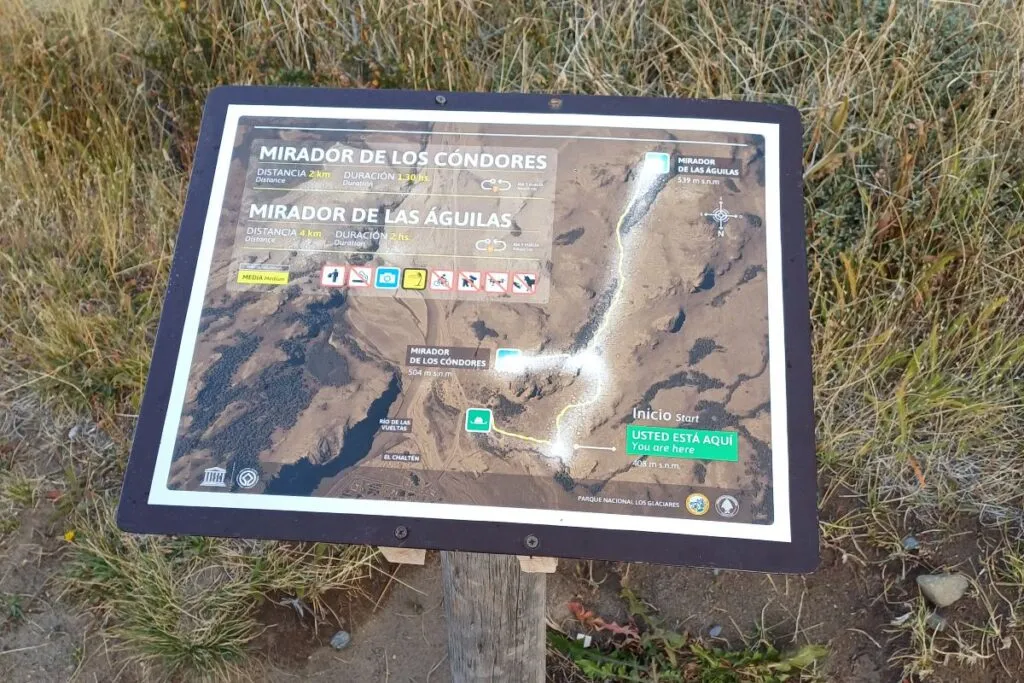
2. Hiking to Condors’ Lookout (Mirador de los Cóndores) offers spectacular views for a first day in El Chaltén.
The starting point of this hike, the guides tell us, is not far from the town’s entrance. The same bridge we crossed a couple of hours ago, we crossed on foot.
It’s 5 pm and the weather is colder. I feel it in spite of the layers I wear. I’m not worried; once I start to walk, I’ll warm up quickly.
One of the guides chats with me while we walk. She tells me about life there in El Chaltén, how long she has been living in town, and what it feels like to stay there all year round, although many only stay for the season.
The wind has become stronger since we left, roughly 10 minutes ago.
We stop at the National Park’s entrance post and show our multiday pass we bought online to access all the trails in the forthcoming days.
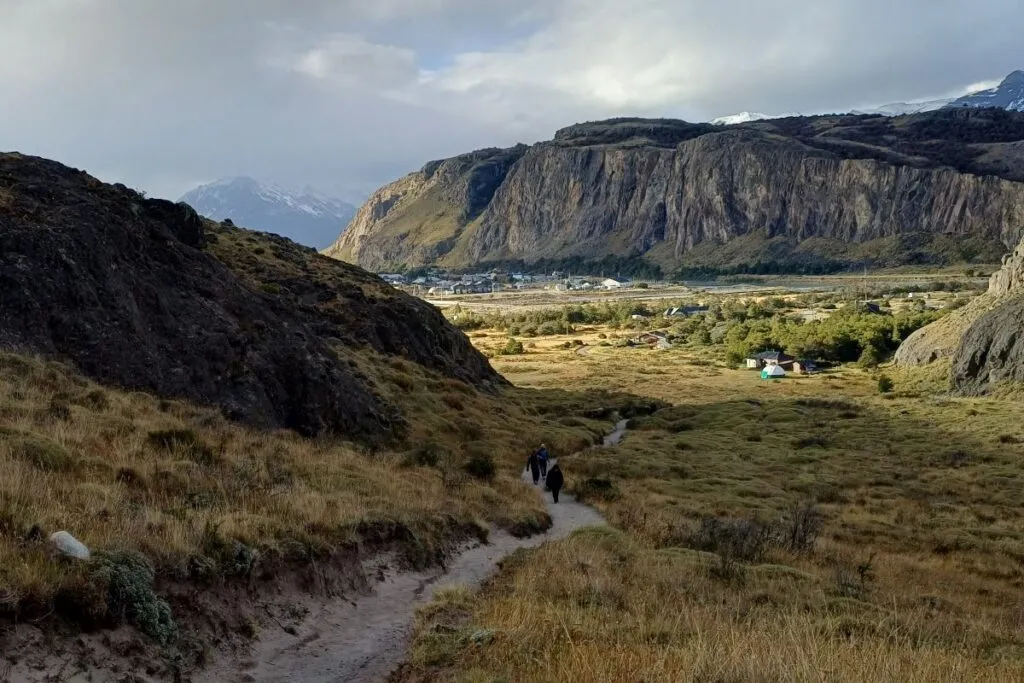
3. Mirador de los Cóndores (2 – 3 hours; 3.7 miles)
We learn about the hike we are about to take, which is classified as a low-difficulty trail, that’s a 3.7-mile round trail (so it will probably take us 2 hours to the top and back into town), and that Condors’ use to overfly the area early in the morning or just before sunset. The chances of seeing them are strong.
The scenery so far, and as promised, is spectacular.
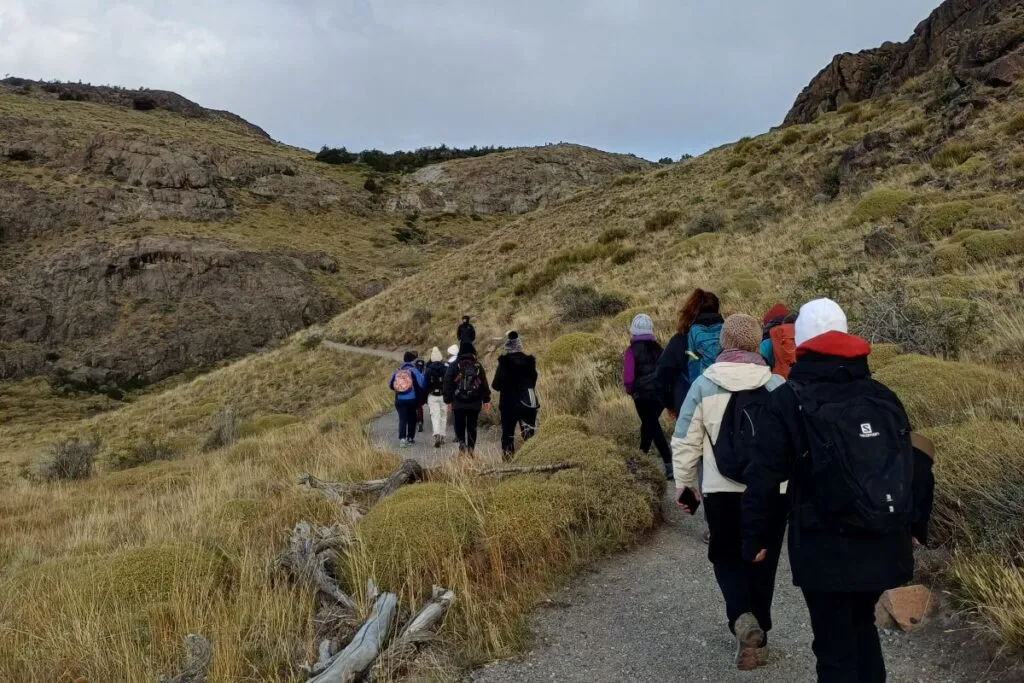
Wind continues to blow us away. The slope doesn’t seem hard to walk on; there are no big rocks, and it is a consolidated soil. Suddenly, I feel my back wet and my breath is agitated. I looked back and realized that, though the gentle path, we have been going up the whole time. The scenery so far, and as promised, is spectacular.
After half an hour, we already see the top.
I walk at the end of the line with another girl and a guide who stays with us at every recovery stop we need. While we can do it to our rhythm, everything will be fine. Plus, the sun is showing its last breath too, which warms us up to the top. We shouldn’t disappoint him.
But the sun also comes with an unpleasant companion, and a frizzing, showering rain starts to fall too. The spectacular scenery is a constant joy and makes us forget the soaring effort.
After half an hour, we already see the top. The open view turns into a little forest into which the trail leads us now. It only takes us a couple of minutes to cross the vegetation back into the open space, and we are almost there. The sun left us, but we started seeing the peak of Mount Fitz Roy, or what was left of it behind the clouds.
In the distance, we suddenly see a condor!
From this height, we see the true dimension of the town, how it is nestled between De las Vueltas and Fitz Roy Rivers, and the mountains. The sun makes a fleeting appearance, glowing over the enormous rocky wall limiting the town on one side; I remember the skyscrapers of Buenos Aires and not missing them at all.
In the distance, we suddenly see a condor! It seems a little bigger than a black stain gliding with the wind. The guide tells us we can distinguish a condor from other birds because, far as we are from it, we can still see the “fingers” of its wings, which is impossible to see in smaller birds. It should be a big-sized bird indeed. I have read that it is one of the biggest birds in the world.I never thought I’d see one in its natural habitat.
Last time I craved hot cocoa, I was 10 years old.
I realized I got tired at the top, but I made it, and my breath is catching up amazingly quickly.
Guides look for a spot more sheltered from the wind and offer hot cocoa, a “mate” (Argentina’s national tea drink) and pastries (called “facturas”). Last time I craved hot cocoa, I was 10 years old. But the hot cup I have now in my hands feels like the most precious and luxurious gift, this high, with these views, under this weather.
We are laughing, we are happy, until…
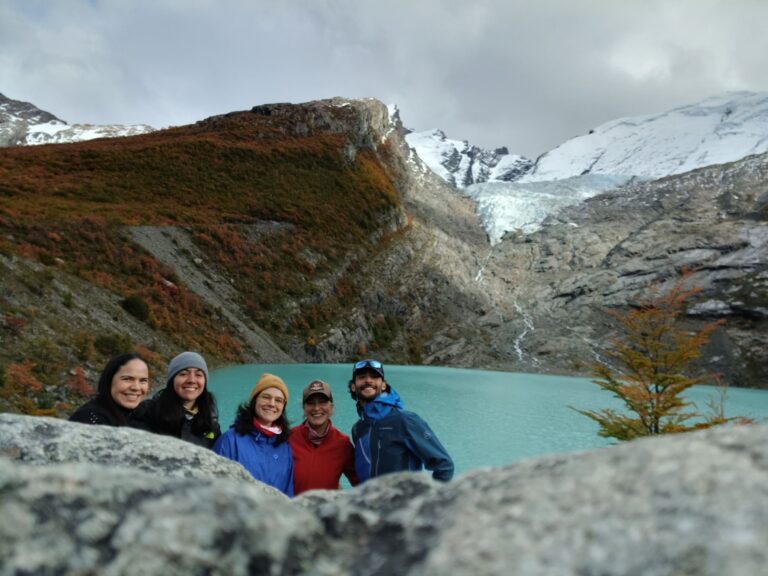
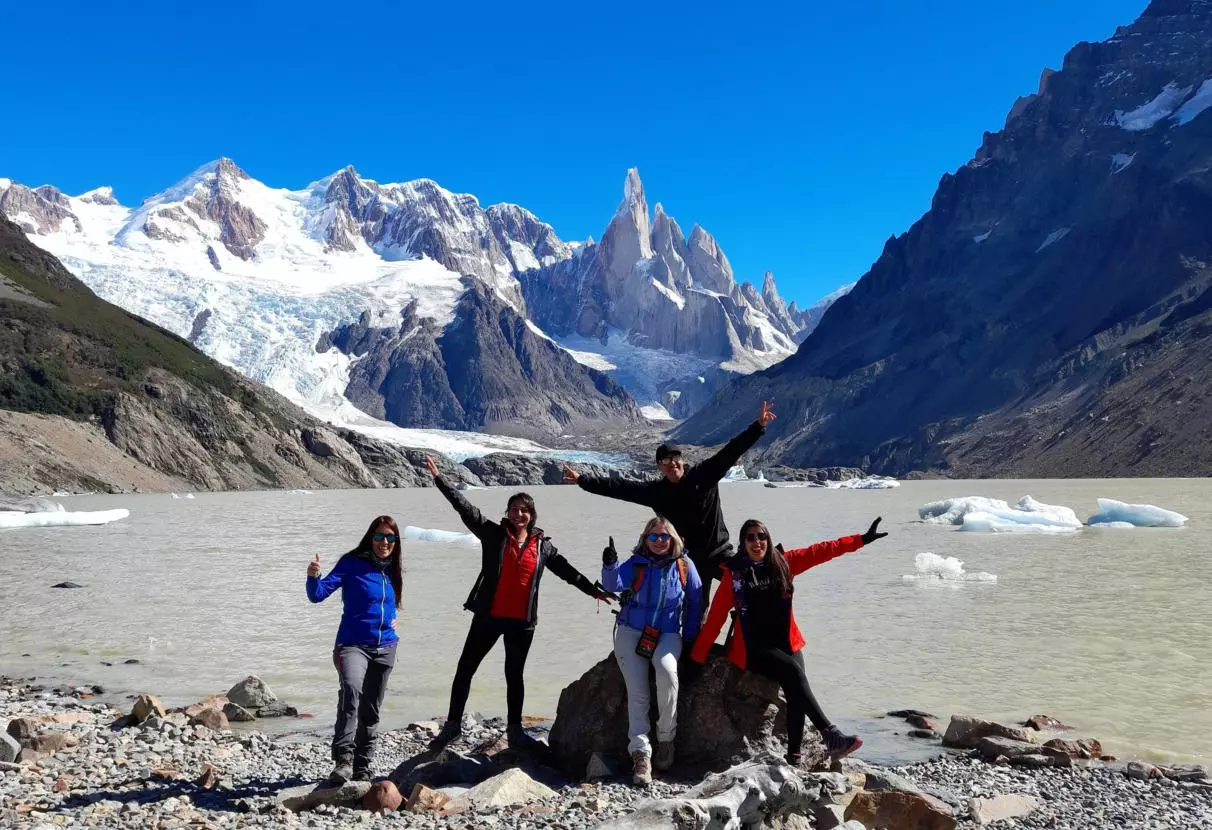
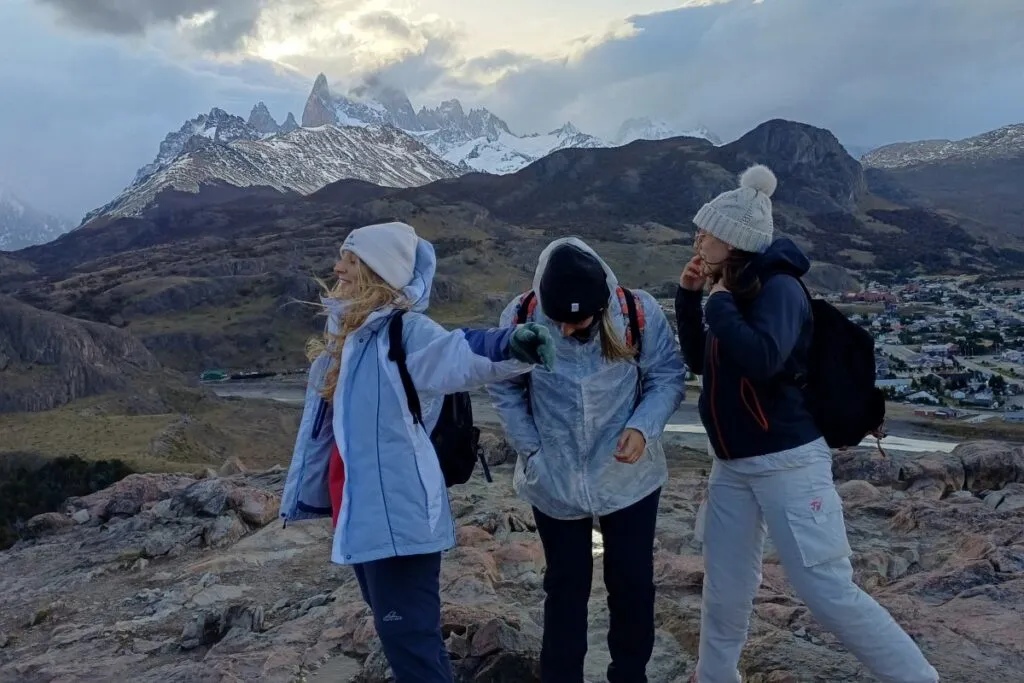
Before heading our way back, I told the girls we should take a picture with the Fitz Roy, covered as it is. A solid proof that we made it for our relatives and friends!
We climbed to a rock from where the view was clear and wide. We are laughing, we are happy to be there, and for our first hiking accomplishment of the trip, until a blow of wind leaves us each standing still in the place it found us.
We try to grab anything nearby. Laughter has turned into a nervous squeal; I feel the mountain has put us, the new to town, in our place. If we were to cohabitate in the forthcoming days, we should enjoy the mountain, but with precaution and respect.
After all, aren’t those mountains there since the world exists? Haven’t they seen much more than us? And all that doesn’t make them, in a way, kind of a divine entity?
We seize a calm window, but the wind will return soon enough. Everyone smiled in the place the wind had left them; we took the picture. None of us has the hair in its place, but we all have a wide smile. And it’s a beautiful memory.
5. Frequently Asked Questions: Mirador de los Cóndores Hike
How hard is the Mirador de los Cóndores hike?
The Mirador de los Cóndores hike is considered easy compared to other trekking routes in El Chaltén. The trail involves a gradual uphill climb, but the short distance and moderate elevation gain make it accessible for most travelers. The main challenge is the Patagonian weather, which can change quickly, so bringing proper layers and comfortable hiking shoes is recommended.
How long does it take?
The hike takes approximately 2 to 3 hours round trip, depending on your pace and the time you spend enjoying the views from the viewpoint. It is a great option to do in the morning or afternoon, especially for travelers looking for a shorter activity after arriving in El Chaltén.
Can beginners do it?
Yes, the Mirador de los Cóndores hike is suitable for beginners and is one of the best introductory hikes in El Chaltén. It does not require previous trekking experience, although a basic level of fitness and comfortable walking shoes will help you enjoy the trail more.
Do you need a guide?
No, a guide is not required for the Mirador de los Cóndores hike. The trail is well marked and easy to follow from El Chaltén. However, travelers interested in learning more about Patagonia’s landscapes, wildlife, and local history can choose to hike with a guide for a more enriching experience.