From pioneering legislation to one of the largest Pride Parades in the world, Buenos Aires is a welcoming destination for LGBT Travelers and queer community in general.
- 1. A recent trend in the LGBT Travelers community: “Close-cationers”?
- 2. South America, an LGBTQ+ welcoming region
- 3. Buenos Aires LGBTQ+
- 4. Mariana Radisic Koliren, Founder of Lunfarda Travel
- 1. In your experience, how do travelers from the community feel when they explore Buenos Aires? What idea of the city do they arrive with?
- 2. What do people ask about or want to know most?
- 3. How would you define the city’s “queer culture”?
- 4. Why did you create the queer tour, and how long have you been running it? How many people attend on average each season? Are they only travelers from the community? Are there families?
- 5. What places (historic sites, bars, museums, fairs, etc.) would you recommend to people who want to learn more about the city’s queer culture and history?
- 5. LGBT Travelers must-visit sites in the city:
1. A recent trend in the LGBT Travelers community: “Close-cationers”?
According to Ladevi, a leading publication of the tourism industry in Argentina, since the beginning of 2026, from 3 million people coming to the country, around 180.000 were LGBT travelers.
The Travel Proud Report 2026, based on the insights of 13300 LGBTQ+ travelers across 19 countries and conducted by Booking.com, shows that only 31% of queer travelers globally are willing not to hide their identity, while the majority choose to be “close-cationers” to feel safer during a trip. In case they can hide parts of who they are.
Contrary to “close-cationers”, 62% of LGBTQ+ travelers globally had negative experiences while traveling related to their sexuality. For trans travelers, the percentage rises to 73%.
2. South America, an LGBTQ+ welcoming region
In this global context, South America has the highest Equality, Legal, and Opinion Index, according to Equaldex’s “Most LGBT-friendly Countries in the world”.
In the country world ranking, Argentina is in 21st position, above countries like the United States, the United Kingdom, Switzerland, and Ireland, and behind France, Spain, Norway, and Iceland.
Within the region, Uruguay, Chile, and Brazil hold better positions than Argentina, which nevertheless features 74/100 as an overall score.
3. Buenos Aires LGBTQ+
Argentina’s LGBTQ Legacy and History
We gather in a corner set by the tour guide. We are in the San Telmo neighbourhood, one of the oldest in the city, and about to start an exploration tour on queer history of Buenos Aires.
San Telmo is famous among visitors and locals because of the imposing San Telmo Market, an architectural piece of art, the antique shops, the weekend art/craft fair, and the tango couples dancing in the main square, Defensa.
Other attractions you can find in San Telmo includes the Museum of Modern History, the Museum of Contemporary Art, but also Pasaje Defensa, a former “conventillo” -tenement house- you can visit for free, the Zanjón de Granados -a system of tunnel in a 19th Century home-, the Minimal house -the narrowest in Buenos Aires- where, a few meters away, we gather today to discover the queer history and culture of Buenos Aires.
During the Colonial era, homosexuality was not penalized, the tour guide explains; it became prohibited during the following periods, which included the Military Coup in 1976.
However, Argentina managed to become the first country in Latin America to legalize same-sex marriage; ID modification, transgender employment quotas, and gender-affirming therapy guaranteed by the State followed.
Signs in the city
The tour guide points out a door on the opposite side of the Minial House. There is a golden sign, and we get closer to read.
It is one of the most recent gains for queer community: A sign pointing out the basement of Marta Ferro, where queer community gathered before, during, and after the Dictatorship.
It took time just for that plaque to exist, but it is there, at 391 San Lorenzo Street.
From there we walk towards Plaza de Mayo Square, surrounded by the Pink House, the Metropolitan Cathedral, and where the Mothers of Plaza de Mayo gather every Thursday to make their historic round around the pyramid.
Mocha Cellis, the first Queer High School
We take the subway and reach the Mocha Cellis, one of the first high schools for members of queer community.
A person from the organization shows us the place and tells us about the different projects ongoing. Most people come to finish high school, and also to learn working skills.
The organization also works as a social network, helping people with housing, clothing, and cultural needs.
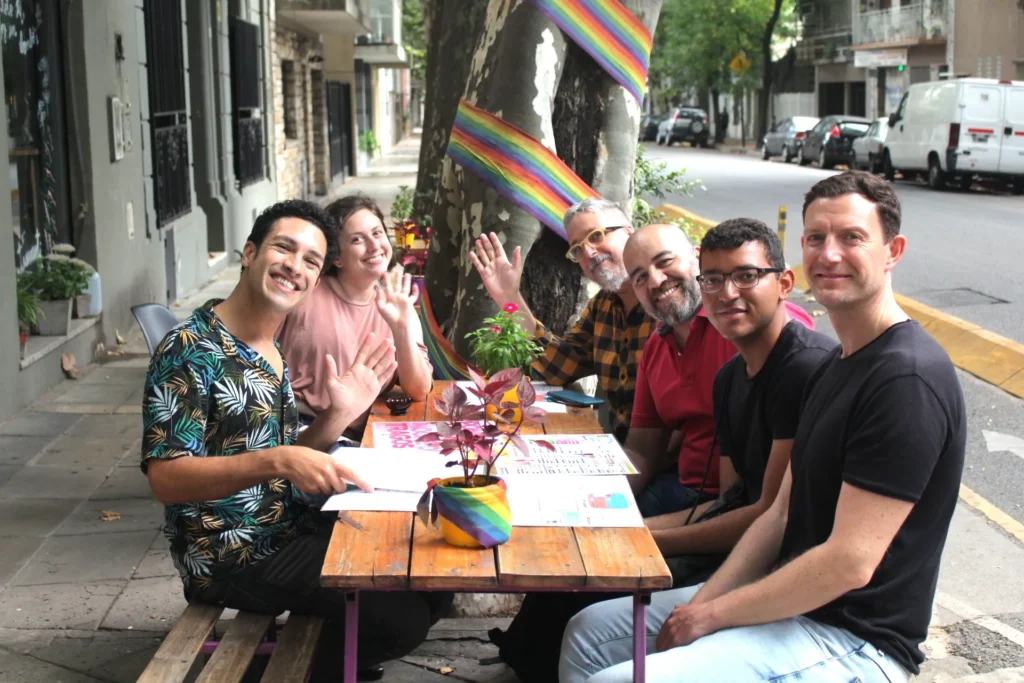
4. Mariana Radisic Koliren, Founder of Lunfarda Travel
1. In your experience, how do travelers from the community feel when they explore Buenos Aires? What idea of the city do they arrive with?
Buenos Aires is a city where queer culture is part of local culture: there are no gay neighborhoods; instead, the entire city has openly community-oriented spaces, and it is easy to see visibly queer people in almost every neighborhood of Buenos Aires. Visitors are surprised by the number of LGBTIQ-owned businesses, the immense number of allied spaces and, above all, the constant public displays of affection within our community. For many visitors, being able to hold hands, kiss or be visibly queer is a right they can fully exercise in Buenos Aires but cannot always experience at home.
2. What do people ask about or want to know most?
People are very interested in our community’s legal struggle, especially considering how young our democratic system is and a past in which Catholicism permeated every sphere of society. In less than 40 years, Argentina went from a dictatorship that disappeared LGBTIQ people to having one of the most advanced legal frameworks in the region. From access to in vitro fertilization covered by health insurance plans for lesbians, to equal recognition of parental rights within marriage, to the Gender Identity Law, Argentina now has legal protections that are widely recognized around the world. For our guides, it is very important to explain that the struggle for LGBTIQ+ rights in Argentina has always been framed as a struggle for human rights, and that this approach has helped Argentina achieve not only those protections but also broad and growing social acceptance, especially in urban centers.
3. How would you define the city’s “queer culture”?
Anarchic, beautiful and self-organized. Buenos Aires has a queer cultural scene that can hold its own against those of other major world capitals. Everything is organized with a great deal of love, resilience and creativity. Something traditionally porteño is the cuir milongas, which break the gender stereotypes so closely associated with tango. The ballroom scene is also remarkable, with more and more houses competing in different categories and showcasing the performative and artistic talent of our community. The intersectionality of the LGBTIQ+ movement in Argentina is also worth highlighting. Broadly speaking, the movement is very trans-inclusive and feminist, and trans comrades have been given a leading political role over the last decade. Speaking of the trans, travesti and nonbinary community, Argentina has Mocha Celis (the first school for the community) and the Trans Memory Archive, which are opening up new horizons for the community and inspiring the international community to develop its own solutions based on those created in Argentina.
4. Why did you create the queer tour, and how long have you been running it? How many people attend on average each season? Are they only travelers from the community? Are there families?
We have been running the LGBTIQ+ tour since 2020. Most of the people who work in our office are part of the community, and our lives have been shaped by this history. When we were born in the 1990s, we had no rights or legal protections. Pride marches were only just beginning at the time, but people covered their faces because of the danger involved. LGBTIQ+ people were either treated as a joke or seen as undesirable in society. That was our childhood. Then, during our adolescence and youth, we watched our movement win rights we had never imagined. I remember the day marriage equality was approved: I could not believe it was happening in my own lifetime. History was changing, but tourism had not caught on.
As I began leading tours, I noticed that the only LGBTIQ+ tourism offerings were gay tours of a sexual nature. While there is a market for that kind of product, it was not what interested us: we wanted to share the cultural and political history of our community and honor the pioneers who, through sheer determination, cleared a path so that we can live freely today.
Today, hundreds of passengers join our tour, cuir tango classes or other experiences each season. We welcome people from the community, their families and allies. We have even welcomed Orthodox Jewish passengers with their trans children. Sharing the intersectional history of our communities openly gives our passengers the freedom to explore our destination without hiding any part of who they are, and that is what motivates us most. For cultural or legal reasons, many people feel they need to hide part of their identity to travel safely. We want people to arrive in Argentina feeling comfortable in their own skin and to experience our destination openly while connecting with our local community. For many people, vacation is the only time they can truly be who they are, and we want that moment to matter and to be part of it.
5. What places (historic sites, bars, museums, fairs, etc.) would you recommend to people who want to learn more about the city’s queer culture and history?
There is a little piece of the community’s history and culture on every corner. On our tour, we visit the lesbians’ basement in San Telmo, the National Congress, the home of gay activist Carlos Jáuregui and Mocha Celis. Mocha Celis High School is the first of its kind: a school established by the trans community to combat illiteracy and encourage education in a community whose rights are still frequently violated. It is a beautiful place that offers a great deal of hope.
To experience the nightlife, there are major events such as Rose Girls Party, a lesbian party organized by the legendary Quimey Toro, and bars including Peuteo, Feliza, Yobla and Casa Brandon, among many others. There is also remarkable activism worth learning about, such as the work of Afros LGBTIQ+ and the LGBT Chamber of Commerce.
But there is still a great deal of work to do to make Buenos Aires’s LGBTIQ+ history visible and bring certain heroes out of the closet. There are entire chapters of our community’s history that we are only beginning to uncover. Thanks to decades of activists who put themselves on the line, we can now live increasingly full, free and open lives; it is also our turn to recover that memory and recognize how much our community has contributed to the country’s cultural and political development. We hope visitors will not only learn that history but take something from it: the inspiration to keep building societies where LGBTIQ+ people can live fully and where their contributions are recognized.
5. LGBT Travelers must-visit sites in the city:
- Casa Brandon: Promoting culture, artists, and professionals from the independent circuit. They offer courses, but also organize festivals, music, and theater shows. You can consult their show schedule for the next events.
- Fiesta Plop: One of the most important parties for queer community in Buenos Aires. It offers a dance hall and a theatrical multimedia show.
- Feliza: It’s a social and cultural queer club; DJ sets, milonga (queer tango hall), and karaoke are some of their proposals.
- If you’re visiting in November: The Pride Parade of Buenos Aires is in November. Find out the exact date this year.