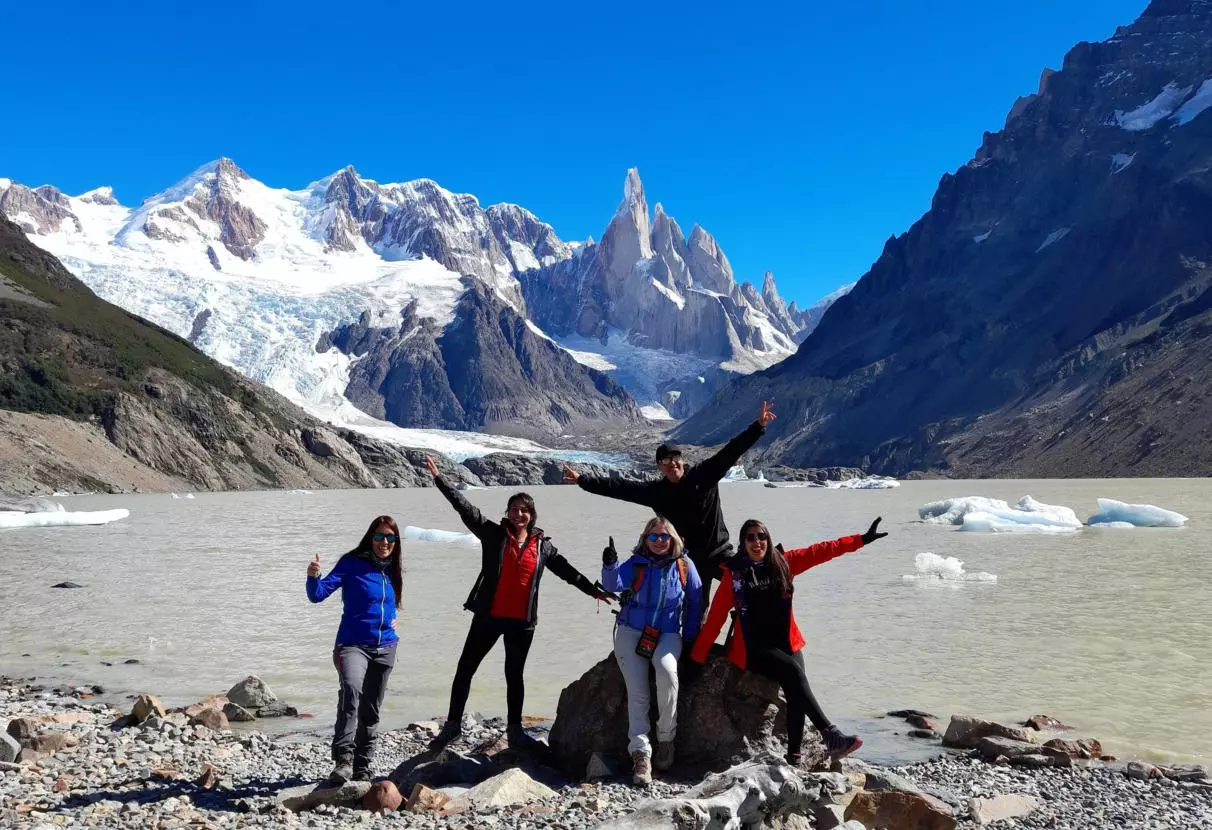
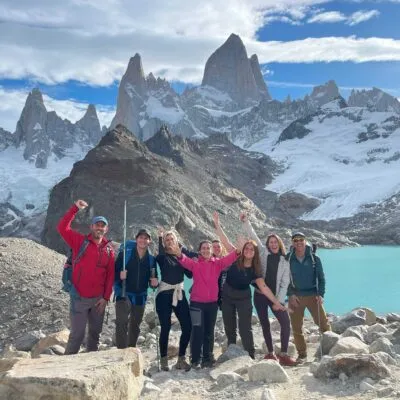
- 1. Fitz Roy Valley Hike starting from the Electric Bridge
- 2. Benefits of booking a private tour guide vs. guided group hiking
- 3. Hiking itinerary for the day: Fitz Roy Valley round circuit, back to El Chaltén
- Piedras Blancas Glacier and Poincenot Campsite.
- Love stories between humans and mountains
- Characteristics of the landscapes on the first part of the trail
- Piedras Blancas Glacier Lookout
- Poincenot Campsite under the pouring rain
- Continue to Laguna de los Tres or choose Laguna Capri? The guide's advice
- Hiking trail from Poincenont Campsite to Laguna Capri and back to town
- What to do in case your gear and clothes get soaked
- How easy we spoil the joy of small things
- Laguna Capri!
- Just one hour away from town and victory
1. Fitz Roy Valley Hike starting from the Electric Bridge
Contrary to what one may believe, it is not infrequent that, after a long day of work or an exhausting year of events, when we should prepare to slow down, the most difficult occurs.
That is what comes to my mind on the last day hiking in El Chaltén, while I see the rain fall from the breakfast room, sip my coffee, and wait for the guide to pick me up.
Rain may stop upon our arrival at the Electric Bridge, the starting point of the Fitz Roy Valley circuit. It is also possible it doesn’t, but I remain optimistic.
Fitz Roy Valley Circuit Hike
| Distance | Approx. 14 miles (22 km) round trip |
| Duration | Approx. 8 – 10 hours |
| Difficulty | Moderate to challenging. The trail includes long distances and a demanding final ascent to Laguna de los Tres, with steep and rocky terrain. |
| Starting point | Electric Bridge (Puente Eléctrico) over Río Eléctrico, located about 15 km from El Chaltén. The trailhead is usually reached by vehicle transfer from town. |
| Park / Reserve pass | No park entrance fee required. The trail is located within Los Glaciares National Park, but this sector does not currently require an entrance ticket. |
| Best time to go | October to April, during the Patagonia trekking season, when weather conditions are generally more favorable and daylight hours are longer. |
2. Benefits of booking a private tour guide vs. guided group hiking
Logistical and mental freedom
I’ve never done a private excursion; I mean, with a guide just to escort me and respond to my needs and not for most of a group.
Now that I think about it, it feels like being a child again, and leaving all the important staff and cares -timetable, condition of the trail, hydration pauses- to groundups.
Fitz Roy Valley, the first famous hike in El Chaltén
The Fitz Roy Valley is the first hiking trail that opened to the public when El Chaltén began to become famous among regular people, not only experienced climbers, hikers, and mountaineering lifestyle lovers.
Around the 90s, when the town was declared “Argentina’s hiking capital”, more people visits the town from where “you can start hiking just by putting a foot out of your hotel” as it is still said today.
Take the Fitz Roy Valley trail, for instance: you can walk to the north by San Martín Av (the main in town) until the concrete ends and falls into a big parking space. Passing through the limits, you enter the first portion of the trail.
Although it still preserves its original appeal, many decided, like us today, to begin at Río Eléctrico’s Bridge… a matter of taste.
Should I have had a champion’s breakfast or not?
One recurrent question I heard during these days being asked to the guides is the doubt about how breakfast should be taken facing a long hiking day. The answer is interesting: you should eat what you usually eat, no more, no less.
The advantage in this kind of hiking is that, even if you go in a group, guides try to slow down to your pace. And if they don’t, it is because they see you enjoying your body discovering so many new things that it doesn’t even notice the effort until you reach the top.
3. Hiking itinerary for the day: Fitz Roy Valley round circuit, back to El Chaltén
Piedras Blancas Glacier and Poincenot Campsite.
The itinerary for today and the main reason to start at Río Eléctrico’s Bridge is to reach Piedras Blancas Glacier First, then the valley until Poincenot Campsite. Then we should decide if we want to continue to Laguna de los Tres or turn round and head back to town, passing by Laguna Capri.
We should decide is just a way of putting it… Weather will rather decide for us. But until then, we’ll enjoy these fictional sensations of power and control we humans tend to have towards Nature.
Love stories between humans and mountains
The first miles are simple, and we talk a lot with the guide. He is not from El Chaltén; like many others, he was born in Buenos Aires until he came to visit a cousin who had recently moved to a little town between the mountains.
It is a strange feeling to be alone with someone you don’t really know in such an unfamiliar place like a mountain path. I’m incessantly talking and asking questions; I can tell. I can’t help it. Getting to know the other person is also a way to feel safe.
And there was not a single soul walking out there, so we really don’t have anyone else to talk to and help the time pass by. Rain has momentarily stopped, giving us a good advantage to move forward and get the most of daylight.
Characteristics of the landscapes on the first part of the trail
Cold doesn’t give respite; we can’t ask that much, I know.
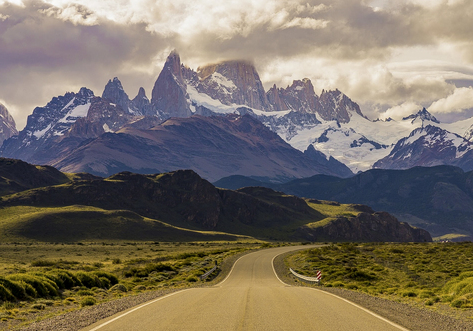
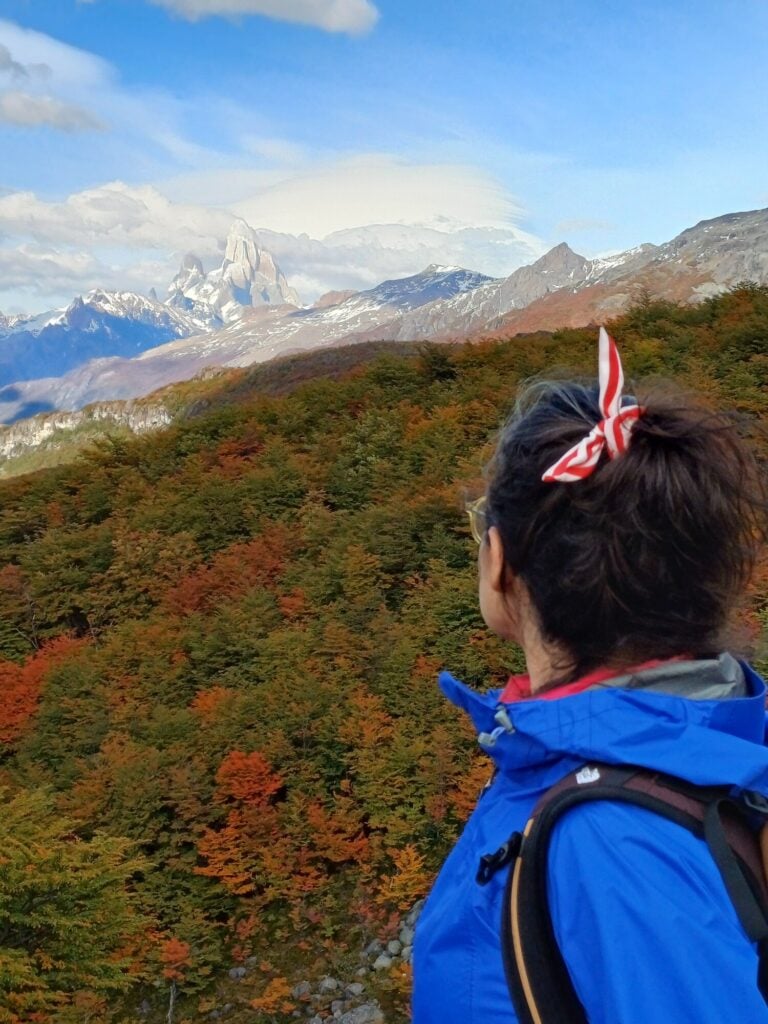
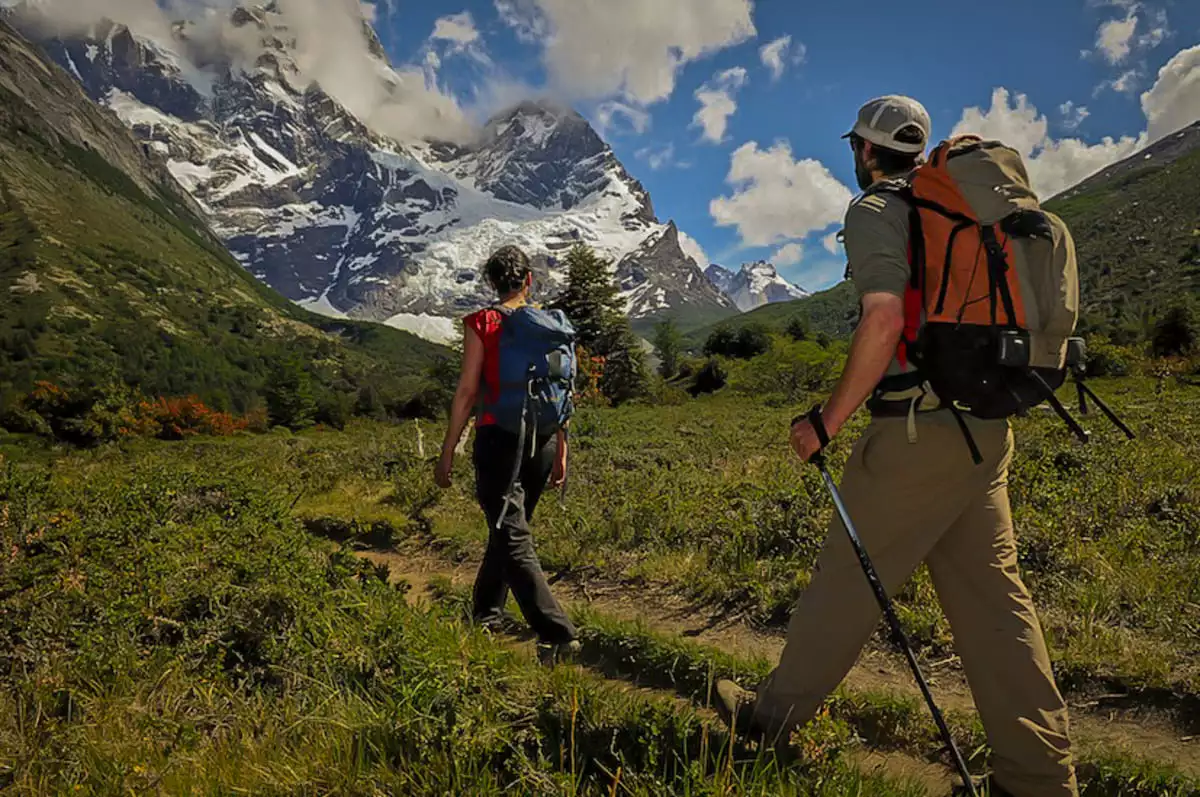
I can tell the landscape is rather different from the other hiking trails I took in El Chaltén. There is no forest around us, but bushes and little trees spread all over and around. The openness of the space and the views also inspire a different kind of sensation.
I can see the mountains constantly and, thus, it is almost impossible to forget their imposing size.
Suddenly, we found life out there: two English-speaking travelers being escorted by a guide, a friend of mine. When my guide asks him if the other speaks Spanish, he says yes. I can tell he is up to something.
My guide goes, with his story to share, willing to make friends.
I feel a little bad for him, but it’s funny to see the puzzled faces of the two travelers, smiling at him, watching him with empty eyes.
When he finishes and goes ahead to catch us up, he is clearly proud and satisfied. The other smiles at me and returns to his confused travelers, and we split our ways again.
By the time we reach a little movable bridge which helps us pass, dry and sound, over a small river flowing through the valley, my sense of loyalty toward my working partner obliges me to confess.
-They don’t speak any Spanish- I say.
My guide stands still, looking back. He searches for his friend’s head between the bushes. We walk faster than them and have already surpassed them by half a mile.
I see him turning his head back, preparing to keep going. I expect to see a frown, but the only thing I notice on his face is an ear-to-ear smile.
Piedras Blancas Glacier Lookout
This is our first steep portion of the trail. We are getting up to the Glacier Lookout and entering a forest. Just on time: Rain started again. And, this time, it won’t stop.
I feel safe with my waterproof boots and jacket, especially made to keep me warm and dry. They do. At least for a while.
The trail starts to get muddy, but I have my walking stick. The slope keeps us continuously ascending, and the tree leaves gift me with supersized drops. Some of them have a perfect aim to fall between my eye and my looking glasses.
By the time we reach the Glacier Piedras Blancas Lookout, I look at the world as if it were a huge sauna bath -the perks of belittle contact lenses.
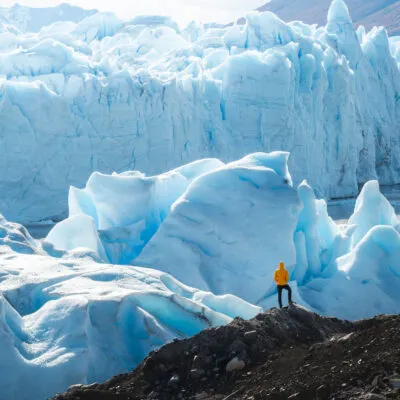
Apart from a group of three sitting in a big rock nearby, we are alone. I try to read the sign explaining interesting facts about the area. Skirting a puddle of water the size of the sign, I succeed and lean out to see the faded figure of the glacier.
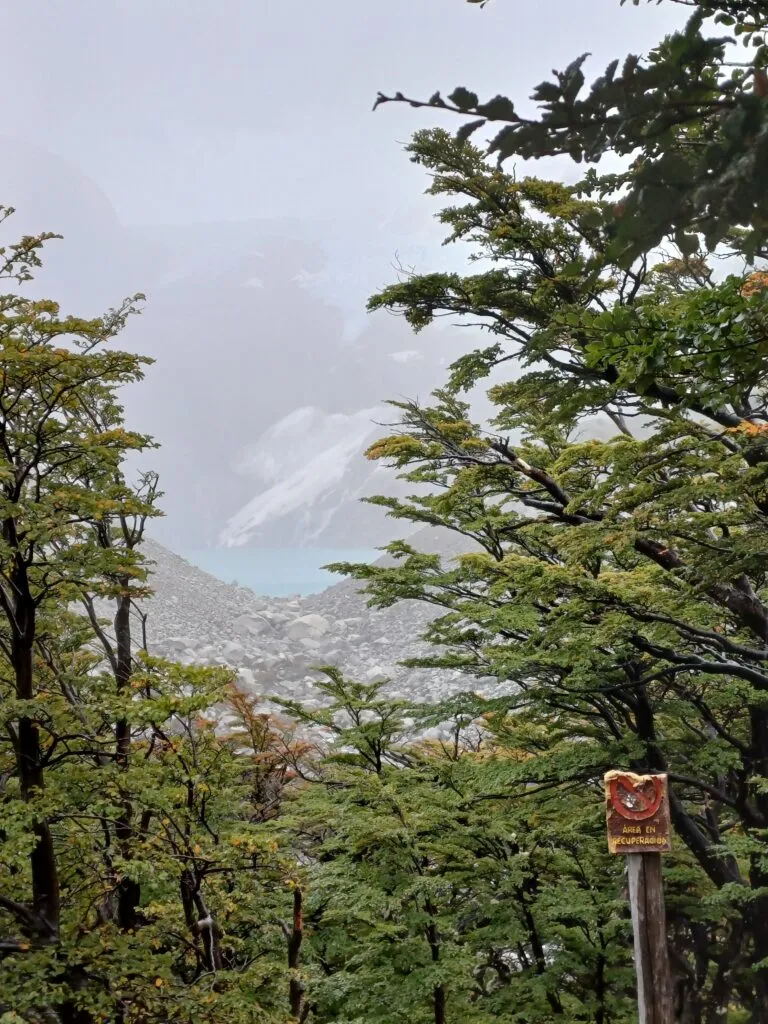
Piedras Blancas Glacier Lookout.
I try to enjoy it, but I really want to keep going to a drier and warmer place. The guide asks me if I want to stop to eat something or take mate, the only version we have of a warm drink.
You must be kidding, I think, but he has a point, and, most importantly, it is his job to keep me happy and healthy.
We should get going, I say, arguing I’m not hungry yet. I see the three travelers still eating, sitting on a rock beneath the trees and their elephant-sized water drops, and it is no way possible they are not wetting their asses.
I refuse to give up on maybe the only part of my clothes that’s still dry. I can keep walking, say to the guide, and take the lead.
We walk straight and fast to keep us warm until Poincenot Campsite, where I hope to find at least a tiny rain-untouched spot.
Poincenot Campsite under the pouring rain
It turns out that when you go hiking on a rainy day, there is no such thing. Dry spots evaporate, and weatherproof clothing turns into a science fiction tale.
This is unusual, the guide says, both standing in the middle of the solitary campsite. I imagine the soil being of a lighter brown than how I see it now. This is really unusual, he repeats to him and me.
I spot a tent, or the project of a tent. It doesn’t seem really solid; maybe the accumulation and the weight of water is an unbeatable enemy for a tent.
There is a man nearby, maybe the owner of the tent. He is soaking wet. I feel the sudden need to approach and say: You don’t have to do this, please, come with us. He moves slowly; drops falling unrestfully from his cap don’t seem to bother him. He seems, after all, happier than me.
Continue to Laguna de los Tres or choose Laguna Capri? The guide’s advice
Another hiker who seems to have just arrived at the campsite like us approaches and starts talking with the guide. He chose to make the hike self-guided, up to Laguna de los Tres, the most difficult trail. But now, under the merciless weather, he is clearly having his doubts.
From Poincenont Campsite you can choose to continue to Laguna de los Tres -the hiking trail most people come to take in El Chaltén- or you can turn back and return to town by a different trail, passing by Laguna Capri.
I wouldn’t recommend it -says my guide-, you won’t have repair up there, and chances are the path will be muddy; you could slide off.
The man stares at him with gentle eyes, not just because he tries to be nice, but because he was born with that look. You can tell when it’s the case. And also, when it is not.
The man thanks my guide and turns back. After a couple of minutes, we stop seeing his back behind the leaves and the forest.
Besides -the guide shares with me, now that the man is gone- I checked out his clothes and gear. He was not well waterproofed. I saw him too; his jacket and boots seemed fine to me. I didn’t know there was a good way to be waterproofed, but then, that’s why he is the guide, and I’m not.
At this point, though my gear was doing a better job than that of the man, there is no possible decision to make: The guide tells me that taking the hike to Laguna Los Tres will be dangerous with this amount of water everywhere. And I feel relief.
Hiking trail from Poincenont Campsite to Laguna Capri and back to town
I have decided I want to get home as fast as we can. I have no desire to eat -besides, where?- and start to be worried about cold, which I feel stronger since my gloves, boots, and jacket have long passed their waterproof limit.
Let’s go, I say the guide, before I get absolutely freezing. He nods and points out the trail. At one point, he had prepared the “mate”. At least -he said- we can walk and warm up with mate. If being given a mate in any situation feels good for an Argentinian, now it feels like Heaven.
Mate is also a good way to deceive hunger and to keep the conversation going. And, in this context, to forget the waterholes under which most of the trail has disappeared. This is not normal, keeps saying the guide; it is not, it repeats, looking at the water flowing down the walking path.
Aren’t you taking me walking on a river? I joked. That is what I usually do when I need to feel braver.
What to do in case your gear and clothes get soaked
The landscape stays beautiful as it was on our way up. But we are still high, and cold feels more intense now. Maybe, if I wasn’t soaking wet by now, it would be different. I’m feeling cold here, in my chest -I said- and I don’t feel much in my fingers under the globes.
Founding a repairing place under a bunch of trees, we stop, although every inch of my body tells me not to, to keep harrying up back home and keep my body warm. But the guide insisted.
Take out the raincoat- he asks- let’s see if your jacket inside is wet -it actually is-, let’s see, I brought this other jacket in case of. Change it and then put on the raincoat again. I also have an extra pair of gloves; put them under yours. I wring them out and twist them, watering the rocks near my feet. Then, I put the others and mine over.
I clenched my hands into a fist, and leave my gloves’ fingers hanging like a rooster’s flaccid comb. I grab each mate, fingerless, and succeed. More than once, should means a kind of developed skill.
I still can’t feel my fingers. Do I have to worry about hypothermia? I ask the guide. No, he says, unfortunately, against hand and fingers, nothing does the trick. Am I not lucky?
He has also brought heat patches, he adds, but those are only for the chest and the back. I feel relief. I decide to put my hands beneath my underarms and wait.
How easy we spoil the joy of small things
At one point, I lost track of time. I have the impression that we have been walking for an hour now. Landscapes have not dramatically changed. At some point, my mind and my body get into a trance; I’m so focused on the task that I wouldn’t mind staying like this the whole day.
But I also want to eat, have a bath, put on dry clothes, go to the toilet -a real one, not a tree or a bush.
In my daily life, I take all that for granted. How easy we spoil the joy of small things, I think to myself. I recovered the feeling in my fingers shortly after the “underarms” warming technique. It felt like saving a life.
This site works as a community of real hikers sharing information and photos of trails they’ve made.
You’ll find technical information about other hikes in El Chaltén, Patagonia, Argentina.
Laguna Capri!
Slowly, the trail has started to go down, and we start to see water on the side, not like we’ve been seeing so far, but a big mirror of water, opening our sight to the mountains on the opposite shore.
There are only 3 other people, my guide’s friend and the 2 English-speaking travelers. They are eating their sandwiches. I separate from the group and walk the rocky shores. And the imposing silence mesmerizes me. If I could, I would build my log cabin here; walking up with this view every day is, suddenly, my most urgent desire.
I can easily see that, on a sunny day, the Laguna Capri and this beach would be even more paradisiac. The guide tells me that, during summer, people climb from town and spend the afternoon taking mate over the lake.
As the rain continues and we have already run out of mate for the day, we start our way down. We have walked nonstop for the last 4 hours, and now less than an hour separates us from town.
Just one hour away from town and victory
Considering all, I’m not starving, feel all my limbs, and haven’t stumble nor once. But it is too early to claim victory.
Town is finally showing its face; these are the last moments of the most challenging and happiest experience I have so far in El Chaltén.
We keep talking with the guide as we were still walking the first miles; he asks about my accommodation for the night -I have to switch hotels- and suddenly I stand still because I can’t remember if I did the necessary arrangements or if I will sleep under the sky tonight.
Somehow, stopping makes me fall; I slide off, and my body glides down until the guide catches me by the arm. “Please”, I beg, “don’t”, I say, “leave me here”, and I start laughing.
We manage to put me on my feet again. Two steps and I fell again: this time, my backpack absorbs most of the impact, and the mud.
Offering again his hand, half worried, half amused, the guide says: “I can not believe how you fell over”. I burst out laughing, put both hands on the ground to stand up again. Fear of getting drenched, of dirtying the clothes, even to survive the day, has long passed by. And I feel liberated.