Discover how group tours in Patagonia work, what to expect, where they go, and why joining a small group can be a great way to explore Argentina’s most iconic landscapes.
- So, Do Group Tours Actually Exist in Patagonia?
- What a Patagonia Group Tour Actually Includes
- Who Actually Joins a Group Tour to Patagonia?
- How Big Is the Group, Really?
- Group Tour vs. Private Trip: The Real Trade-Off
- What Does a Group Tour Cost Compared to Going Private?
- Joining a Group Tour in Patagonia as a Solo Traveler
- When a Group Tour Is the Wrong Choice
- How to Choose a Good Group Tour
- Booking, Timing and Availability
- Frequently Asked Questions
Yes. That’s the short answer, and if it’s all you needed, you can stop reading.
But the question is almost never really “do they exist?” It’s a stand-in for a cluster of quieter worries that people don’t always say out loud.
Will I be the only solo person surrounded by couples? How big is the group actually going to be? Am I locked into a fixed itinerary with no room to breathe? And is it just the cheap option dressed up as sociable?
Those are the real questions, and they have real answers — some reassuring, some worth knowing before you book.
Group tours are not simply a discount version of a private trip. They’re a different way of travelling, with genuine advantages and genuine trade-offs, and they suit some travelers superbly and others not at all.
So this is the complete picture on group tours available in Patagonia: what the Patagonia group travel options actually are, who joins them, how big they get, what they cost relative to going private, and how to tell a good one from a coach with a flag.
It’s written for the person weighing whether to join a group or organise their own trip, and for the solo traveler wondering whether Patagonia is a place you can comfortably do alone.
The honest version, throughout — including where a group is the wrong answer and you’d be happier doing something else.
So, Do Group Tours Actually Exist in Patagonia?
They do, and there are more of them than the region’s remote reputation suggests.
Patagonia is one of the most sought-after destinations in South America, and that demand has produced a healthy market for scheduled group departures — fixed dates you join, rather than a trip built from scratch around you.
They run across the season, roughly late October to March, with the highest frequency in the December-to-February peak. Some operators now run shoulder-season departures in November and March too, which are often better value.
The format most worth knowing about is the small-group guided tour: a set itinerary, a fixed departure date, a shared guide, and a capped number of travelers.
Our own guided group departures in Patagonia — the Patagonia Essentials departures are a ten-day loop through the region’s must-sees, built specifically with solo travelers in mind.
So the existence question is settled. The useful questions are about format, company and fit — which is the rest of this article.
What a Patagonia Group Tour Actually Includes
“Group tour” covers a range, so it’s worth knowing what a well-built one actually contains before you compare prices.
A typical small-group Patagonia departure runs nine to twelve days and hits the icons: El Calafate and the Perito Moreno Glacier, El Chaltén and Fitz Roy, and frequently a crossing into Chile for Torres del Paine.
Included, on a good one: accommodation throughout, daily breakfast, internal transfers, the named excursions with their guiding, and a tour leader who runs the logistics so you don’t have to.
Not included, usually: international flights, some internal flights, most lunches and dinners, travel insurance, and tips. The same exclusions as any Patagonia trip, and worth totalling before comparing.
The defining feature is the fixed itinerary. Everyone on the departure follows the same programme, which is what makes the shared price and the shared guide possible in the first place.
That structure is the whole trade. You give up the ability to change the plan, and in return you get a tested route, company, and a lower cost than going private. Whether that’s a good deal depends entirely on you.
Who Actually Joins a Group Tour to Patagonia?
This is the question behind the question, especially for solo travelers, and the honest answer is reassuring.
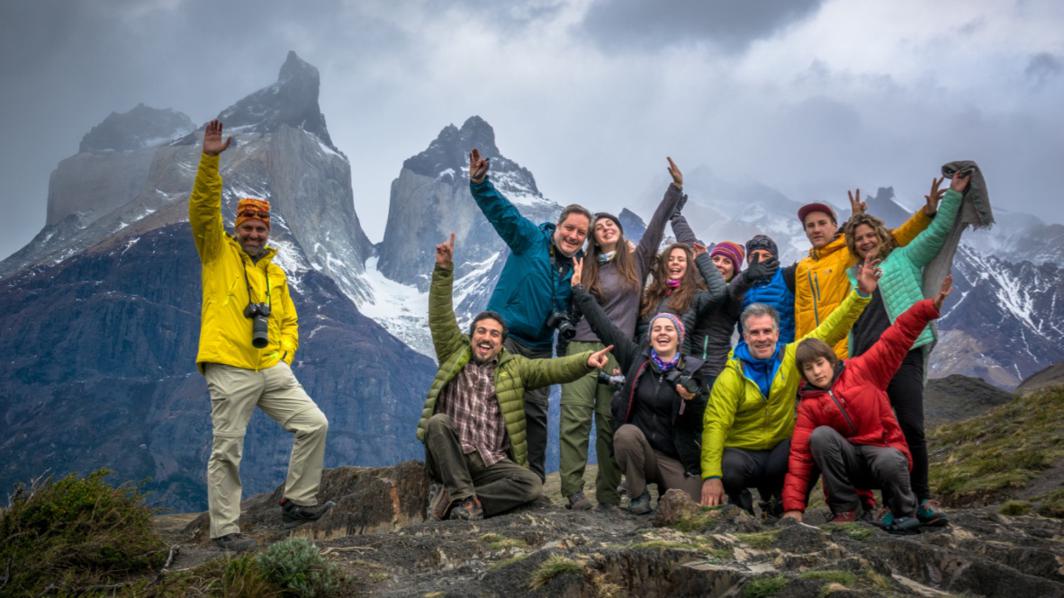
Solo travelers are the core of most small-group Patagonia departures — often the majority. Tours like the Patagonia Essentials are explicitly designed around them, which changes the whole social texture.
If a group is built for solos, you are not the odd one out among couples. You’re among the people the trip was made for, and that difference is enormous in practice.
The rest tends to be a mix: pairs of friends, the occasional couple who prefer company to privacy, and a wide age range that skews toward the thirties-to-sixties bracket in Patagonia specifically.
What binds them isn’t demographic. It’s disposition — people who chose a group because they wanted the company, the shared meals, and the ease of not organising everything themselves.
Which means the group self-selects for sociability. The people who’d hate a group tour don’t book one, so the ones you meet are, almost by definition, the ones you’d want to travel with.
For a solo traveler nervous about Patagonia, this is the single most important thing to understand: you will not be alone, and you will not be surrounded by honeymooners.
How Big Is the Group, Really?
Group size is the number that matters most and the one operators are vaguest about, so it’s worth pinning down before you book.
The phrase to distrust is “small group”. Everyone uses it, and it means anything from eight people to twenty-eight.
A genuinely small group in Patagonia is roughly eight to sixteen. At that size you fit in one vehicle, you can hear the guide, restaurants can seat you without a month’s notice, and the group stays nimble when weather forces a change.
Above about twenty, the experience changes character. You’re into coach territory, waiting on stragglers, splitting across tables, and moving at the pace of the slowest — which in Patagonia’s weather is a real cost, not a minor one.
So don’t accept “small group” as an answer. Ask for the maximum number, in writing, and treat the willingness to give a firm figure as a signal in itself.
Smaller groups also tread more lightly, which matters in a landscape this fragile — fewer vehicles, less pressure on small trails and smaller lodges. The environmental case and the experiential case point the same way.
Group Tour vs. Private Trip: The Real Trade-Off
This is the decision most people are actually trying to make, and it’s usually framed wrongly — as cheap versus good. It isn’t that.
A group tour buys you three things: a lower cost, built-in company, and zero planning burden. You show up on a date and the trip happens around you.
What it costs you is control. You travel when the group travels, you eat when the group eats, and when the weather turns, the itinerary adapts for everyone rather than for you.
A private trip inverts all of that. Your dates, your pace, a guide who reorders the week around a forecast, and the freedom to spend a second day somewhere you loved. It costs more, and it’s worth more the more particular you are.
The clean way to decide: if the fixed itinerary is a relief, take the group. If it’s a constraint you’re already resenting, take the private trip.
| Group Tour | Private Trip | |
| Cost | Lower, shared across the group | Higher, built around you |
| Pace | The group’s | Yours |
| Company | Built in | Just your own party |
| Flexibility | Fixed itinerary and dates | Fully adaptable |
| Best For | Solo travelers, sociable travelers, tighter budgets | Couples, families, particular tastes, specific dates |
What Does a Group Tour Cost Compared to Going Private?
Group travel is the most economical way to see Patagonia well, and the reason is structural rather than promotional.
You’re splitting the expensive parts — the guiding, the transfers, the coordination — instead of carrying them alone.
We won’t publish a fixed figure here, because Patagonia prices move with season and availability and any number would be wrong within months. But the structural saving against an equivalent private itinerary is significant and consistent.
What matters more than the headline is what’s inside it. A cheap group tour with a guide shared across twenty-six people and lodging ninety minutes from the park is not a bargain — it’s a different, lesser trip.
So compare like with like: group size, lodging location, and which flights and meals are included. A slightly dearer small-group departure often delivers far more than the cheapest coach.
Our group departures sit deliberately at the small-group end for that reason, sometimes with Smart Travel Deals on specific dates worth asking about.
Joining a Group Tour in Patagonia as a Solo Traveler
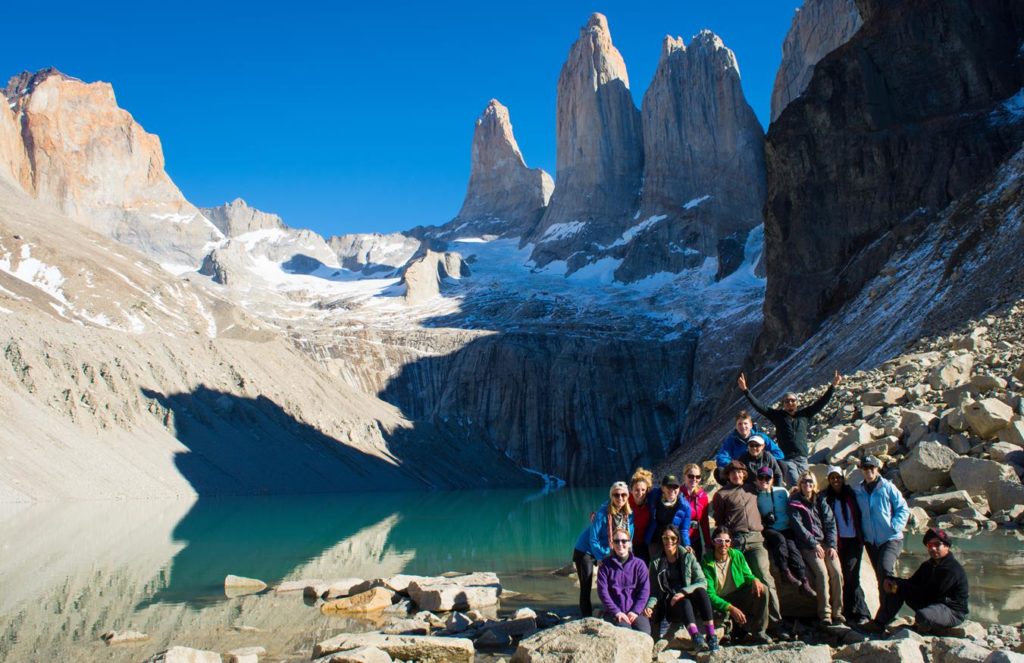
Patagonia is one of the best places in South America to travel solo, and joining a group tour is the most natural way to do it. Here’s how joining a group tour in Patagonia actually works in practice.
- You book onto a scheduled departure the way you’d book a flight: a fixed date, a set itinerary, a price per person. You’re not assembling anything — you’re joining something already running.
- The one line item solo travelers should check is the single supplement. Because tour pricing assumes two people sharing a room, solo travelers sometimes pay a surcharge for a room to themselves.
- Ask whether the departure offers a room-share option that waives the supplement — many do, pairing you with another same-gender solo traveler — or whether the single supplement is built in. It’s the difference that most affects a solo budget.
- Socially, the structure does the work for you. Shared meals, shared vehicles, and a tour leader whose job includes making sure nobody eats alone on night one.
By day three, most solo travelers report the group feeling less like strangers and more like the people they’ll swap photos with for a year. That’s the part you can’t buy in a private trip, and for many solos it’s the entire point.
When a Group Tour Is the Wrong Choice
We’d rather talk you out of a group tour than sell you one you’ll resent, so here’s when it isn’t the answer.
- If you have fixed, inflexible dates that don’t match any departure, a group tour simply won’t fit. Scheduled tours run when they run.
- If you’re travelling as a family with young children, a mixed-ability group rarely works — the pace that suits a nine-year-old and the pace that suits other adults are not the same, and someone ends up unhappy.
- If you’re a couple who came to Patagonia for the solitude and the silence, a group of fourteen is the opposite of what you’re paying for. Go private.
- If you have very particular interests — serious photography that needs to wait for light, hardcore trekking, a specific wildlife obsession — a general group will frustrate you. These want a tailored trip.
- And if the idea of eating every dinner with the same fourteen people sounds like a sentence rather than a pleasure, listen to that instinct. It’s telling you something true.
None of this makes group travel worse. It just makes it wrong for you, which is a different and more useful thing to know.
How to Choose a Good Group Tour
Group tours vary enormously in quality, and the differences are checkable if you know what to ask.
- Ask the maximum group size, and get a number. “Small” is not a number.
- Ask where you’ll be sleeping, by name and by distance from the parks. Location beats star rating in Patagonia, and cheap group tours cut it first.
- Ask who the tour leader is and whether they’re a local specialist or a generalist flown in. In Patagonia the guide largely is the trip.
- Ask about the single supplement and the room-share option if you’re solo, because it materially changes the price.
- And ask what happens when the weather closes a trail — a good operator has a specific answer and a local team to execute it, not a shrug.
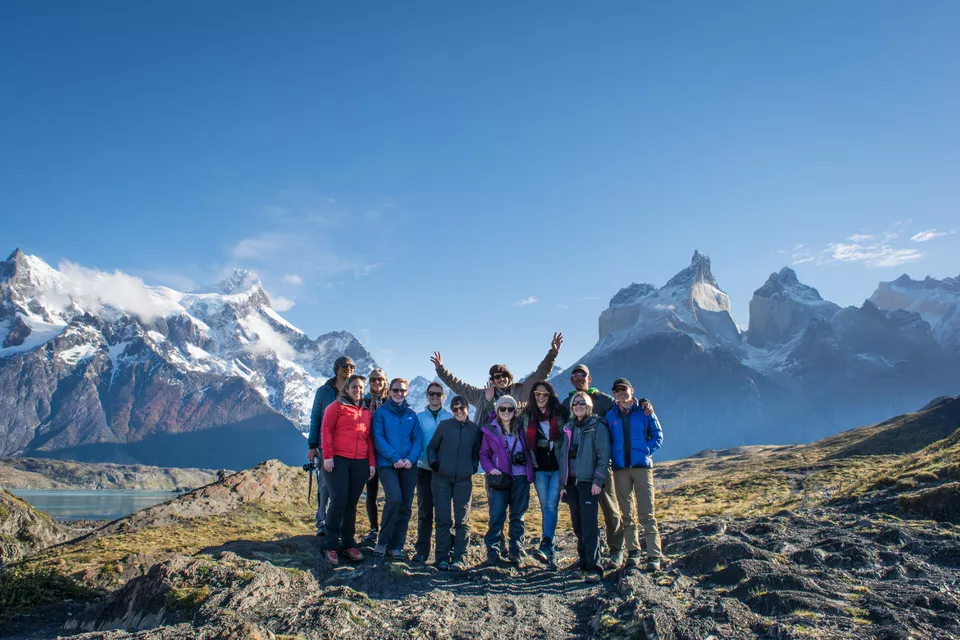
The same instincts that identify a good operator generally apply here. If you want to see how the region’s destinations actually suit groups, our guide to the best places for a group trip to Patagonia is a useful companion to this one.
Booking, Timing and Availability
Group departures have one advantage over private trips on timing, and one disadvantage, and both are worth understanding.
The advantage: because the itinerary and rooms are pre-arranged in a block, a group departure can sometimes absorb a later booking than an equivalent private trip could.
The disadvantage: popular departures sell out, and once a date is full, it’s full. You can’t simply add yourself to October if October is booked.
For peak-season departures between December and February, booking six to nine months ahead is sensible. For the quieter November and March dates, you often have more room — and a better trip, with thinner crowds and softer prices.
If you’re a solo traveler hunting the room-share option, book earlier rather than later, because the pairing depends on another solo traveler of the same gender also being on that date.
If a scheduled departure doesn’t fit your dates, a small private group built around your own people is the alternative, and our travel specialists can tell you quickly which of the two makes more sense for you.
Frequently Asked Questions
Are there group tours available in Patagonia?
Yes, and more than the region’s remote reputation suggests. Patagonia is one of South America’s most popular destinations, and there’s a healthy market of scheduled small-group departures you can join on fixed dates.
They run across the season from late October to March, most frequently in the December-to-February peak, with some operators adding better-value shoulder departures in November and March.
The most common format is the small-group guided tour: a set itinerary, a fixed date, a shared guide, and a capped number of travelers — frequently designed with solo travelers in mind.
Are Patagonia group tours good for solo travelers?
They’re one of the best ways to travel Patagonia solo. Solo travelers are the core of most small-group departures — often the majority — so you’re among the people the trip was designed for rather than the odd one out among couples.
The structure does the social work: shared meals, shared vehicles, and a tour leader who makes sure nobody eats alone on the first night.
The one thing to check is the single supplement. Ask whether the departure offers a room-share option that waives it, which many do by pairing you with another same-gender solo traveler.
How big are group tours in Patagonia?
It varies widely, and “small group” is used loosely enough to be meaningless on its own. A genuinely small group is roughly eight to sixteen people.
At that size you fit in one vehicle, can actually hear the guide, and the group stays flexible when weather forces a change of plan. Above about twenty, it becomes coach travel — waiting on stragglers and moving at the slowest pace.
Always ask for the maximum group size as a firm number rather than accepting “small,” and treat a clear answer as a good sign in itself.
Is a group tour cheaper than a private Patagonia trip?
Yes, meaningfully, and for structural reasons rather than promotional ones. But cheaper isn’t automatically better value. A low-priced tour with a guide shared across twenty-six people and lodging well outside the parks is a lesser trip, not a bargain.
Compare like with like — group size, lodging location, and which flights and meals are included. A slightly more expensive small-group departure often delivers far more than the cheapest coach.
Can I join a group tour if I have specific dates?
Only if your dates match a scheduled departure, because group tours run on fixed dates rather than adapting to you. If your dates are firm and nothing lines up, a group tour won’t fit.
In that case, a small private group built around your own travelling companions is usually the better route — you keep the company and much of the ease while choosing your own dates.
If your dates are flexible, you have more options, and the November and March departures tend to offer both better availability and a better overall experience than the peak months.
When should I book a Patagonia group tour?
For peak-season departures between December and February, six to nine months ahead is sensible, as popular dates sell out and a full departure can’t simply be extended.
For the quieter November and March dates you generally have more room, along with thinner crowds and softer prices — often the better trip overall.
Solo travelers hoping to use a room-share option should book earlier rather than later, since the pairing depends on another same-gender solo traveler also choosing that date.