This city boasts a variety of libraries where you may escape the chaos of the city with a good book. If you are looking for a library in Buenos Aires, take into consideration the following!
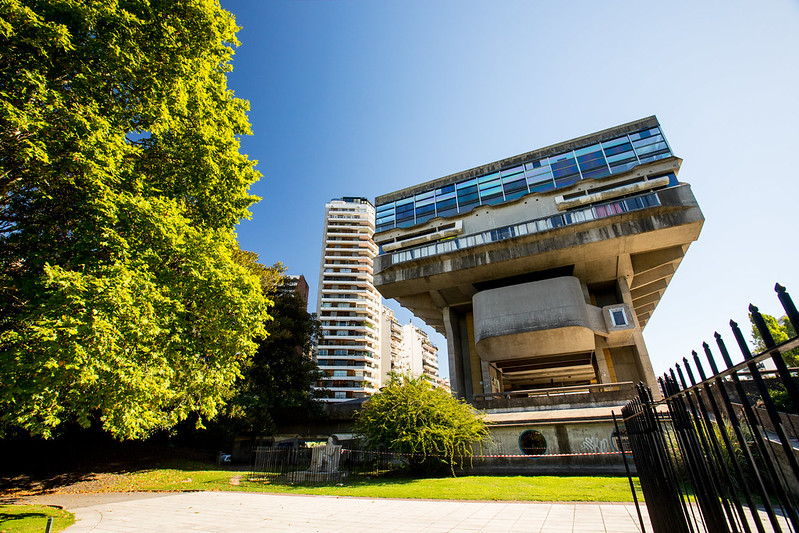
National Argentine Library (Biblioteca Nacional Argentina)
This is not only Argentina’s largest and most extensive collection of knowledge, but it is also the most influential in Latin America. Mariano Moreno founded the library in Microcentro more than 200 years ago, and it was relocated to Montserrat before finding its current location in Recoleta. The property, which was originally held by Unzue Place, was taken over by the state in 1937 and become the official residence of Juan Peron and his wife, Eva ‘Evita’ Peron. She died in the ocean-facing expansion. When Peron was banished, the palace was demolished, and the modern library of Buenos Aires was erected on the site.
Library of the National Congress (Biblioteca del Congreso de la Nación)
This huge library, located adjacent to Congress, has served as a resource for legislative members and the general public for over 150 years. Visitors pass through security and enter a high-ceilinged lobby with authentic marble and bronze torsos of Rivadavia and San Martin. Despite housing a massive collection of nearly three million items, the library’s layout is simple. Everything is located within a single wide foyer that is segregated into areas for multimedia, reading, reference, and microfilm, which displays newspapers dating back to 1810.
National Library of Teachers (Biblioteca Nacional de Maestras y Maestros)
Located in the center of Buenos Aires, this library opened in 1870 and has a sumptuous façade that is matched by its glamorous inside, which is immaculate, large, and light. Under the high ceilings, beige, green, and pinks surround mahogany, with towering bookshelves emphasizing a desire for education by virtue of their height. The Biblioteca Nacional received a beautiful reading room with the construction of the Sala Americana, which opened in 1998 and is accessed by a spiral staircase in the main hall. Sala Americana, which is less busy than the rest of the library, exudes grandeur with its draped windows and vintage lighting.
National Military Library (Biblioteca Nacional Militar)
This library, located in front of the Plaza San Martin and hidden inside the Circulo Militar, evokes the pervasive military presence in Buenos Aires. The edifice, designed to scream nobility, is too extravagant to be useful and should not be overlooked – even if you’re not a martial arts lover. The reading room’s leather-bound desks, mirrored walls, and marble fireplace combine to give a sense of grandeur, and even the entrance is gold-plated. The collection contains nearly 60,000 publications on themes such as war strategy, martial history, and foreign military journals from the United States, Brazil, and France. The library is open to the public, but it only holds 15 people at a time, so plan your visit appropriately.
Station Park Library (Biblioteca Parque La Estación)
Inaugurated in 2019, the Station Park Library was built on what used to be the 11 de Septiembre station of the Sarmiento Railway. The building combines the classic architecture of the train station with green areas to relax.
This modern library of Buenos Aires with media and newspaper tools is located in the neighborhood of Balvanera, giving readers the chance to borrow all kinds of books in a friendly atmosphere where it’s also possible to practice sports.
Leopoldo Lugones Library (Biblioteca Leopoldo Lugones)
This library, founded in 1907 under the name Biblioteca Popular de Belgrano, had its first headquarters in Juramento 2148. When the neighborhood residents’ committee could no longer afford its maintenance, it passed into the hands of the Municipality of Buenos Aires, which assigned its current building. and changed his name to Leopoldo Lugones.
Today it is part of the Network of Libraries of the City of Buenos Aires, and has one of the largest bibliographic patrimonies, with a total of 22,756 volumes.
The building has 2 floors for reading rooms. On the first floor is the Tesoro Library, which houses first editions and books of great historical value, such as the Archive of the Newspaper La Gaceta de Buenos Aires.
Since 2001 the library has had the children’s annex La Fontaine, with books by Mafalda, Clemente, the Robin Hood Collection (children’s literature classics), among other titles, and a video room with children’s films.
Reading House Library (Biblioteca Casa de la Lectura)
The Reading House was reopened in October 2017, as the first Model Library of Buenos Aires, where children, young people and adults can enjoy a bright and modern space, with collaborative work tables, connectivity, access to the heritage of modern narrative as well as the entire network catalog and a new digital library.
The Casa de la Lectura has a collection of 3,000 titles and offers books on loan or for face-to-face reading in the genres of narrative, essay, poetry, chronicle and journalism.
The monthly program includes workshops on literature, art, music and technology. It runs from Monday to Sunday and aims to make Casa de la Lectura a place for artistic and multidisciplinary research.